
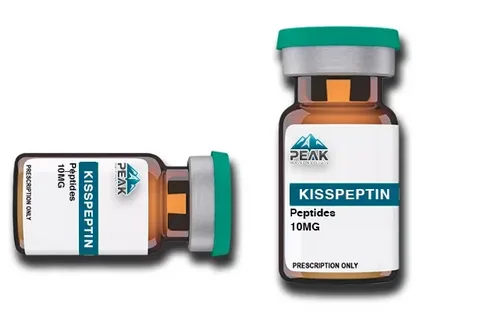
Kisspeptin‑10 (also known as KP‑10) is the smallest fully bioactive fragment derived from the kisspeptin peptide family, originating from the KISS1 gene. This decapeptide consists of the amino acid sequence Tyr‑Asn‑Trp‑Asn‑Ser‑Phe‑Gly‑Leu‑Arg‑Phe‑NH₂
Key Biological Roles
-
Reproductive Hormone Activation
Kisspeptin‑10 binds with high affinity to the G‑protein‑coupled receptor GPR54 (also known as KISS1R), stimulating the release of GnRH (gonadotropin-releasing hormone), which in turn drives the secretion of luteinizing hormone (LH) and follicle-stimulating hormone (FSH)—critical for puberty and fertility -
Tumor Suppression
Originally discovered as part of the KISS1 metastasis-suppressor gene, kisspeptin‑10 acts as an inhibitor of tumor spread in cancers such as melanoma and breast cancer -
Cardiovascular Effects
It acts as a potent vasoconstrictor and can inhibit angiogenesis—the formation of new blood vessels American Heart Association Journals. In heart tissue, Kisspeptin‑10 promotes collagen deposition, influencing cardiac fibroblasts through focal adhesion kinase (FAK) activation. This leads to increased collagen types I and III, reduced matrix metalloproteinase (MMP) activity, and elevated tissue inhibitors (TIMPs)—contributing to myocardial fibrosis Nature. -
Metabolic & Other Roles
Emerging research links kisspeptin to broader metabolic processes, including regulation of glucose homeostasis, feeding behavior, body composition, and cardiac function Frontiers.
Summary Table
| Feature | Details |
|---|---|
| Origin | Derived from KISS1 gene; 10-amino acid bioactive fragment |
| Receptor | Binds GPR54/KISS1R, triggering GnRH → LH/FSH release |
| Physiological Roles | Puberty initiation, fertility regulation, tumor suppression, vasoconstriction |
| Cardiac Impact | Promotes collagen deposition via FAK, affecting heart structure |
| Metabolic Influence | Involved in glucose metabolism, appetite, and cardiovascular health |
| MG | 5mg*10vials, 10mg*10vials |
|---|---|
| Cat. No | KS5, KS10 |
Be the first to review “KissPeptin-10Kisspetin”
Related products
peptides
peptides
peptides
peptides
peptides
peptides
peptides
peptides
Reviews
There are no reviews yet.